Insights

Our Blog

Insights, articles, and updates from Marcos Thomassen Povoa and the Stormberry team.

Generative AI task integration
03/Sep/2026

Generative AI task integration

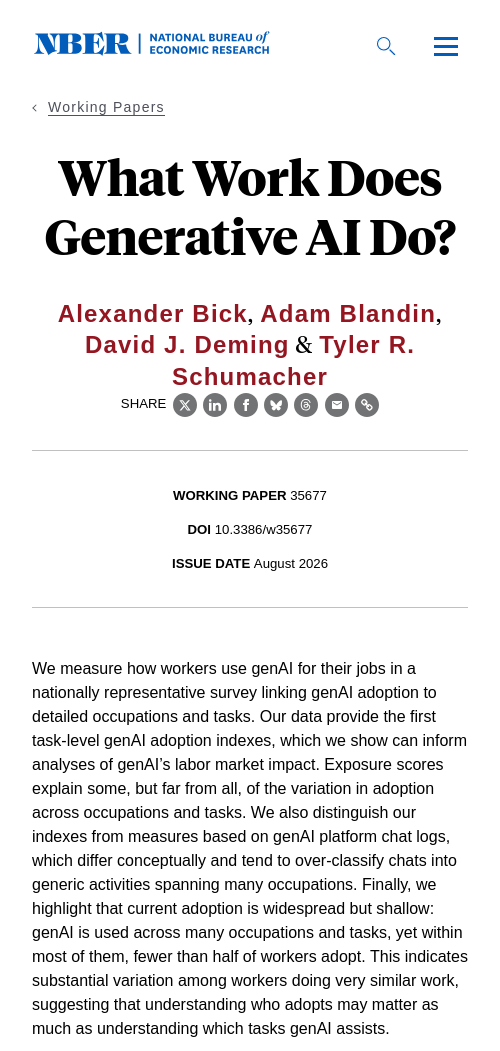
Generative AI now reaches 80 per cent of occupations and more than 40 per cent of tasks. In most of those occupations, fewer than half the workers actually use it. Only 2.8 per cent of tasks show adoption above 50 per cent. None passes 70.

That is the shape of a tool that has been made available and not yet built into how the work gets done. Everybody has access. Almost nothing has become the default method.

The distinction matters when you are the one paying. Licence counts and login rates measure distribution. They say nothing about whether a task got faster, cheaper or more consistent, and they are the numbers most likely to appear on the slide when someone asks how the rollout is going.

If you have bought seats, pick three or four specific tasks and measure those instead. Time to produce a quote. Hours spent on monthly reporting. Rework on a standard document. If none of them moved, the answer is not more training. It is that the tool was never wired into the work.

The task-level adoption table is the part of the paper to read, not the occupation-level figures. Mapping your own highest-volume tasks against it is a short piece of work, and it is where Stormberry starts an AI review.

Source: NBER, August 2026.
https://www.nber.org/papers/w35677
Read Full Post on LinkedIn
Customer resistance to AI
02/Sep/2026

Customer resistance to AI

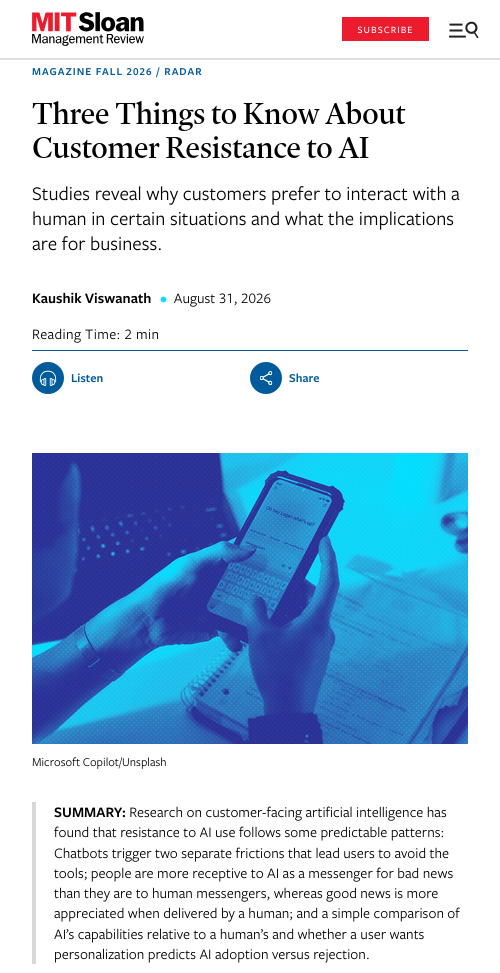
Three findings on how customers respond to artificial intelligence, from research summarised by MIT Sloan Management Review.

First, people avoid the chatbot even when it costs them nothing. Participants chose it only 28 per cent of the time when the wait was identical either way.

Second, and more useful, the effect is not symmetrical. Across studies with more than 82,000 participants, customers accepted a worse-than-expected offer 78.6 per cent of the time when it came from a machine, against 60.4 per cent from a person. But humans were better at delivering a better-than-expected offer, 89 per cent against 76. The explanation is that nobody reads intent into a system. There is no generosity to credit and no meanness to resent.

Third, a meta-analysis of 163 studies puts adoption down to two things: whether the customer believes the machine is capable, and how much personalisation the task needs.

That last pair is a better test than choosing by department. Before you automate anything customer-facing, sort your interactions by whether the customer expects to be recognised. Start where they do not. Keep a person where they do, and wherever you have good news to give.

Source: MIT Sloan Management Review, 2026-08-31

Read Full Post on LinkedIn